

Overview
The mining industry plays a significant role in national economic development and has a major impact on daily life. Reliable communication systems are essential for supporting mining production and operational safety. They help integrate information monitoring and management, strengthen coordination between departments, and improve overall production and operational efficiency.
Industry Challenges
Harsh operating environments
Mining personnel operate in extremely demanding conditions where dust, sediment, and moisture can negatively affect the performance and durability of communication equipment.

Remote locations
Mining sites are often located in remote areas where carrier network coverage is limited or unavailable, making reliable communication difficult to maintain.

Segnova’s Solution
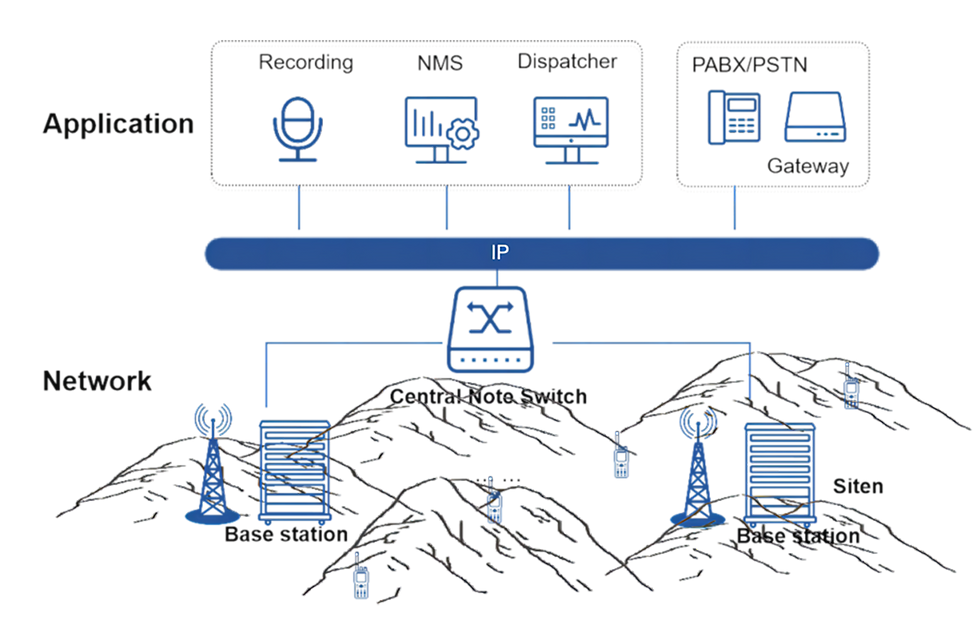
Segnova provides communication solutions based on DMR Tier III trunking systems and ruggedized radios, designed specifically for demanding mining environments.
The DMR Tier III trunking system supports high traffic capacity with powerful operational features and enhanced safety capabilities. The system is built on an ALL-IP infrastructure, allowing channel capacity and network sites to be expanded easily as communication needs grow. It also supports integration with the mining office’s telephone system for improved coordination.
Ruggedized radios such as the DP680 and DP9 series comply with MIL-STD-810 C/D/E/F/G and IP67 standards, ensuring reliable performance in dusty and wet mining environments.
Key Benefits
Powerful Functions
The system supports group calls, individual calls, local calls, and system calls, along with GPS positioning and dispatching services, meeting the daily communication needs of mining personnel.

Stable and Reliable
With a distributed controller software architecture and multiple fault-tolerant designs, the system ensures stable and reliable communication across mining operations.

Secure Communications
All voice data and control traffic are encrypted, and radios are securely authenticated. Devices can also be remotely disabled or re-enabled if they are misplaced or stolen, helping maintain operational security.
